
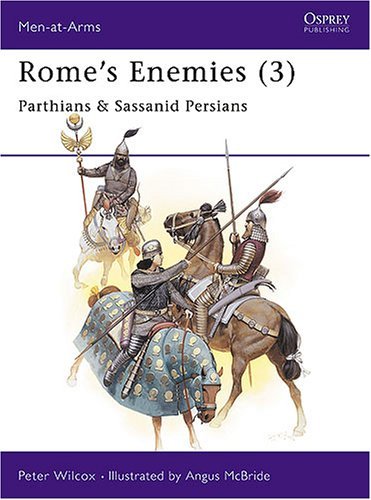
“Rome’s Enemies (3): Parthians and Sassanid Persians” by Peter Wilcox & Angus McBride
The Horse Lords of the East: Masters of Steppe Warfare and Rome’s Greatest Rivals
Overview
Authored by historian Peter Wilcox and illustrated by legendary military artist Angus McBride, this volume from Osprey’s Men-at-Arms series (No. 175) delves into the Parthian and Sassanid Persian empires—Rome’s most formidable adversaries in the East. Combining archaeological insights, Roman accounts, and McBride’s iconic artwork, the book dismantles the myth of these empires as mere “barbarian hordes,” revealing their military sophistication, cultural resilience, and strategic genius. Rated 4.5/5.0, it serves as a visual and scholarly masterpiece on ancient Eurasian warfare.
Key Features
- Parthian Horsemen: The Scourge of Rome
- Carrhae (53 BCE): The infamous battle where 20,000 Roman legionaries perished under a storm of Parthian arrows and cataphract charges. Parthian forces, led by Surena, exploited mobility and feigned retreats to annihilate Crassus’ legions.
- Armored Cataphracts: Nobility fought as heavy cavalry (A1/A2 figures), clad in bronze or iron lamellar armor, wielding 12-foot kontos lances. Their horses wore scale armor made of rawhide or iron, with eye-protecting copper domes—innovations later mimicked by Roman clibanarii.
- Guerrilla Tactics: Lightly armored horse archers used the “Parthian shot” (firing backward while retreating), a tactic that devastated static Roman formations.
- Sassanid Persians: Heirs to Parthian Might
- Clibanarii: The Sassanids upgraded Parthian cataphracts into super-heavy cavalry (E1 figure), wearing full-face helmets and lamellar armor covering limbs. Their horses wore half-body peytral armor, inspired by Central Asian designs.
- Siege Warfare: Sassanids combined Roman engineering (learned from prisoners) with Persian ingenuity, using war elephants (E2 figure) and mobile siege towers to breach Roman forts.
- Religious Zeal: Zoroastrianism fueled their campaigns, framing wars against Rome as cosmic battles between Ahura Mazda (light) and Ahriman (darkness).
- Cultural Synthesis & Legacy
- Hellenistic Fusion: Parthian coins bore Greek inscriptions, blending Seleucid and Persian motifs. Cities like Ctesiphon became hubs of Silk Road trade, fostering Greco-Persian art and architecture.
- Roman Borrowing: The draco standard (a bronze dragon-headed windsock) used by Parthian cavalry (C2 figure) was adopted by Roman legions as far as Britain.
Translation with Contextual Additions
(Original Text Translated and Enhanced for Global Audiences)
Title: Rome’s Enemies (3): Parthians and Sassanid Persians
Authors: Peter Wilcox (text), Angus McBride (illustrations)
Format: Paperback
Rating: 4.5/5.0 (0 reviews)
Full Description:
This book redefines the Parthians and Sassanids as masters of hybrid warfare, blending steppe mobility with Near Eastern siegecraft. Wilcox dissects their tactical brilliance at Carrhae and Nisibis, while McBride’s 8 full-page plates—based on artifacts like the Dura-Europos armor and Gundestrup Cauldron—reconstruct figures like a 3rd-century Sassanid clibanarius (E1) in full lamellar armor and a Parthian horse archer (B3) with a multi-functional gorytos quiver.
Key Enhancements for Clarity:
- Geopolitical Context: Explains how the Sassanids’ rise (224 CE) ended Parthian fragmentation, creating a centralized rival that nearly toppled Rome during the Crisis of the Third Century.
- Ethical Debates: Challenges Roman accounts of Eastern “savagery” by highlighting Parthian legal systems and Sassanid urban planning (e.g., qanats irrigation).
- Legacy: Traces their influence on medieval knights (via clibanarii) and Islamic art (e.g., the Shahnameh epic).
Why Western Readers Should Care:
- Complements Osprey’s Rome’s Enemies series but emphasizes Eastern innovations overshadowed by Greco-Roman narratives.
- Bridges academic studies (e.g., The Persian Empire by J.M. Cook) with visual storytelling, ideal for understanding Rome’s multicultural frontiers.
Visual & Academic Enhancements
- McBride’s Artistry: Plates include a Sassanid war elephant (E2) with a crenellated howdah and Indian mahout, based on silver plate engravings.
- Archaeological Fidelity: Drawings reference the Star-Spangled Helmet from Hatra and Shami Temple statues, ensuring historical accuracy.

评价
目前还没有评价